A mathematical analysis of Frederic Rzewski's Coming Together
This is the starting point of the piece, or the "seed". It consists of 7 notes ascending the G minor pentatonic scale.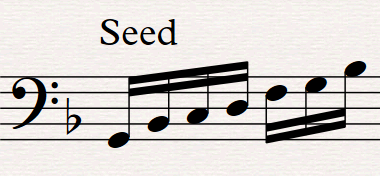
From this, let's create the pattern A, by first taking the first note of the seed, then the first 2 notes, then the first 3 notes etc. until we get all 7 notes.

Let's take a moment to consider the different ways we could have developed the seed.
We could have started with the whole pattern and instead of adding notes, subtract notes.
We could also have started with the last note of the seed and added notes before.
Finally, we could have chosen to play the seed backwards instead of forwards.
Because we have 3 different choices between 2 options, we can create \(2^3=8\) different patterns.
So, for the pattern A, we chose to:
Pattern A:
1) Start with one note and then add notes.
2) Start with the first note of the seed and then add notes after it.
3) Play the seed forwards.
Pattern B:
1) Start with the whole seed and then subtract notes.
2) Subtract notes from the end of the seed.
3) Play the seed forwards.

Pattern C:
1) Start with one note and then add notes.
2) Start with the first note of the seed and then add notes after it.
3) Play the seed backwards.

Pattern D:
1) Start with the whole seed and then subtract notes.
2) Subtract notes from the beginning of the seed.
3) Play the seed backwards.

Pattern E:
1) Start with one note and then add notes.
2) Start with the last note of the seed and then add notes before it.
3) Play the seed forwards.

Pattern F:
1) Start with the whole seed and then subtract notes.
2) Subtract notes from the the beginning of the seed.
3) Play the seed forwards.

Pattern G:
1) Start with one note and then add notes.
2) Start with the last note of the seed and the add notes after it.
3) Play the seed backwards.

Pattern H:
1) Start with the whole seed and then subtract notes.
2) Subtract notes from the end of the seed.
3) Play the seed backwards.

We can calculate the number of notes in each pattern with Gauss's formula: \(1+2+3+4+5+6+7\)\(= \sum_{i=1}^{7}i=7*8/2=28\)
We notice that Gauss's formula implies that the sum of numbers from 1 to 7, i.e. 28, has to be a multiple of 7. This will come useful later.
Now, all of this will become pretty meta. We will reiterate the same process on the 8 patterns to create the 8 sections of the piece.
Let's take the pattern A. We first take the first note of the pattern, then the 2 first notes, then the 3 first notes etc. until we get all 28 notes of the pattern. Doing so, we get the following result (this is just the beginning):

Once the pattern is full, we then subtract notes from it, starting from the beginning. Once there are no notes left, the section is over.
So each section will have \(1+2+3+4+...+27+28+27+\)\(...+3+2+1 = \)\(\sum_{i=1}^{28}i+\sum_{i=1}^{27}i\) \(= 28*29/2+27*28/2\)\(= 406+378=784 \) notes.
We notice that \(784=28^2\). This is a specific case of the general assumption that \(\sum_{i=1}^{n}i+\sum_{i=1}^{n-1}i=n^2\)
Indead, \(\sum_{i=1}^{n}i+\sum_{i=1}^{n-1}i\)\(=n(n+1)/2+(n-1)n/2\)\(= n/2((n+1)+(n-1)) \)\(= n/2*2n = n^2\)
Because \(784 = 28^2 = 4^2*7^2 = 16*49\), we can divide each section into 49 measures of 16 notes each. Because \(49=7^2\), we can separate these 49 measures into 7 groups of 7 measures.
So, the piece has 8 sections of 49 measures each, so \(8*49 = 392\) measures, and \(8*7=56\) groups of 7 measures.
Let's now add lyrics to the piece. They will be separated into 8 groups of 7 lines each. The vocalist must say one line for each measure.
Group A: I THINK
THE COMBINATION
OF AGE
AND A  GREATER COMING TOGETHER
IS RESPONSIBLE
FOR THE SPEED
OF THE PASSING TIME
________
Group B: IT’S SIX MONTH NOW
AND I CAN TELL YOU
TRUTHFULLY
FEW PERIODS
IN MY LIFE
HAVE PASSED
SO QUICKLY
________
Group C: I
AM
IN
EXCELLENT
PHYSICAL
AND EMOTIONAL
HEALTH
________
Group D: THERE DOUBTLESS
SUBTLE
SURPRISES
AHEAD
BUT I FEEL
SECURE
AND READY
________
Group E: AS LOVERS
WILL CONTRAST
THEIR EMOTIONS
IN TIMES
OF CRISIS,
SO AM I DEALING
WITH MY ENVIRONMENT,
________
Group F: IN THE INDIFFERENT BRUTALITY,
THE INCESSANT NOISE,
THE EXPERIMENTAL CHEMISTRY OF FOOD,
THE RAVINGS OF LOST HYSTERICAL MEN,
I CAN ACT
WITH CLARITY
AND MEANING
________
Group G: I AM DELIBERATE
SOMETIMES EVEN CALCULATING
SELDOM
EMPLOYING HISTRIONICS
EXCEPT AS A TEST
OF THE REACTIONS
OF OTHERS.
________
Group H: I READ MUCH,
EXERCISE,
TALK TO GUARD AND INMATE,
FEELING FOR
THE INEVITABLE
DIRECTION
OF MY LIFE
As said previously, the piece has 56 groups in total. Because \(56=2*28\) and \(28=1+2+3+4+5+6+7\), we can again use incrementation and decrementation as follows:
A
AB
ABC
ABCD
ABCDE
ABCDEF
ABCDEFG
BCDEFGH
CDEFGH
DEFGH
EFGH
FGH
GH
H
Regrouping 7 consecutive groups into one section, we get the following:
Section A: AABABCA
Section B: BCDABCD
Section C: EABCDEF
Section D: ABCDEFG
Section E: BCDEFGH
Section F: CDEFGHD
Section G: EFGHEFG
Section H: HFGHGHH
That's what I call clever!